


Incoterms
Incoterms® 2020 are standardized trade terms (e.g., FCA, FOB, and CIF) issued by the International Chamber of Commerce (ICC).
The Iceland Chamber of Commerce is a member of the ICC. Incoterms® 2020 enable exporters to provide price quotations in which the allocation of costs and risks incurred during the transport of goods between the seller and the buyer is clearly defined.
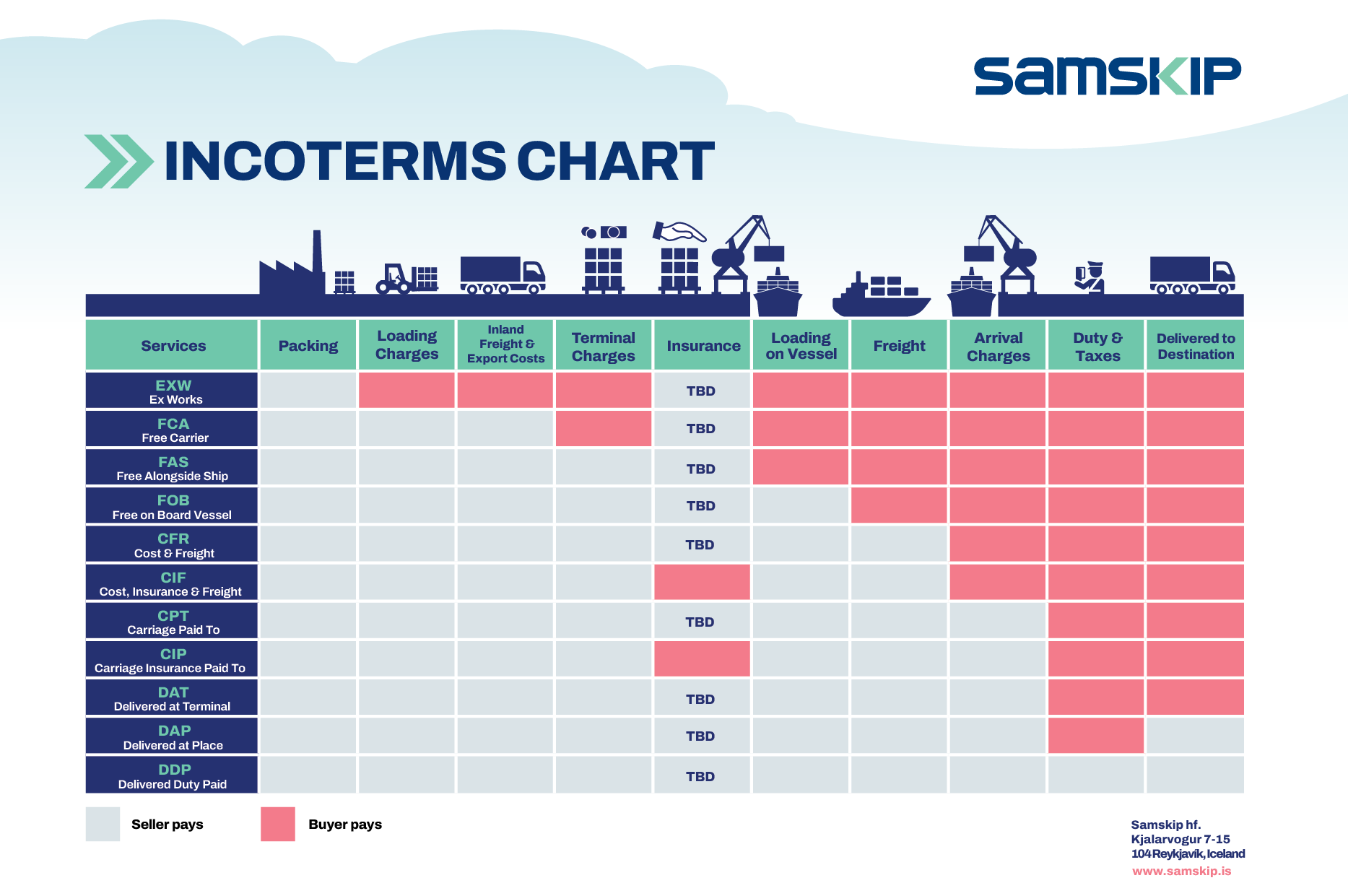
There are eleven (11) Incoterms®, which can be viewed as steps in the transfer of responsibilities for transport, payment of costs, and the risk of loss or damage from the seller to the buyer. EXW (“Ex Works”) is the Incoterm that places the fewest obligations on the seller and is typically used when delivery of the goods takes place at the seller’s premises. At the other end of the scale is DDP (“Delivered Duty Paid”), which places the greatest obligations on the seller and is used, for example, when delivery takes place at the buyer’s premises.
The Incoterms® that apply exclusively to sea and inland waterway transport are:
FAS, FOB, CFR, and CIF.
The Incoterms® that apply to containerized transport and all modes of transport, including multimodal transport, are:
EXW, FCA, CIP, CPT, DAT, DAP, and DDP.
IMPORTANT NOTE: Incoterms® are terms of sale in a contract between the buyer and the seller and should not be confused with contracts of carriage between the shipper and the carrier. However, trading parties should provide carriers with clear information on which Incoterms® are used in the sales contract. This ensures that the contract of carriage aligns with the contract of sale.
Incoterms® address the allocation of costs and risks between the seller and the buyer, as well as certain obligations related to customs clearance, insurance, and division of responsibilities (e.g., who is responsible for customs clearance). There may, however, be additional terms that need to be specifically defined in the contract, beyond the Incoterms® themselves.
Sellers should therefore:
- Specify how delivery is to be carried out, in particular, who is responsible for loading and unloading.
- Specify the type and level of insurance required, as well as its geographical and temporal scope (where and when coverage begins and ends).
- Specify requirements or restrictions regarding means or modes of transport (e.g., refrigerated containers, not to be stowed on deck, etc.).
- Ensure that the contract includes provisions on force majeure, limitation of liability (“exoneration”), or time limits if they are responsible for customs clearance or delivery at an inland destination in a foreign country.
Please note that this is far from an exhaustive explanation of Incoterms®. Further information is available on the Incoterms® 2020 website: http://www.iccwbo.org
Brief Description of Incoterms® 2020
EXW
Ex Works (named place, e.g., ex works at a named factory or location)
The seller delivers the goods at its premises, not cleared for export and not loaded onto any means of transport. If the parties wish the seller to be responsible for loading and to bear the cost and risk of loading, this must be clearly stated in the sales contract.
FCA
Free Carrier (named place)
The seller delivers the goods to the carrier nominated by the buyer at the named place. These terms apply to all modes of transport, including air, rail, road, and multimodal transport, including containerized cargo. The seller is responsible for export clearance and related charges.
FAS
Free Alongside Ship (named port of shipment)
The seller delivers the goods alongside the vessel at the named port. The seller is responsible for export clearance and related charges. These terms apply only to sea and inland waterway transport.
FOB
Free On Board (named port of shipment)
Delivery occurs when the goods pass over the ship’s rail at the port of shipment designated by the buyer. From that moment, the buyer bears all costs and risks. The seller is responsible for export clearance and charges. This term applies only to sea and inland waterway transport and is not suitable for containerized or multimodal transport.
CFR
Cost and Freight (named port of destination)
The seller pays the costs and freight necessary to bring the goods to the named port of destination. However, delivery and transfer of risk occur when the goods pass over the ship’s rail at the port of shipment. This term applies only to sea and inland waterway transport and is not suitable for containerized or multimodal transport.
CIF
Cost, Insurance and Freight (named port of destination)
The same as CFR, except that the seller must also procure and pay for insurance on the goods. The seller is only required to obtain minimum insurance coverage unless otherwise agreed. This term applies only to sea and inland waterway transport and is not suitable for containerized or multimodal transport.
CPT
Carriage Paid To (named place of destination)
The seller delivers the goods to a carrier of their choice and pays the transport costs to the named destination. Risk and any additional costs are transferred to the buyer once the goods have been delivered to the carrier. These terms may be used for all modes of transport, including multimodal and containerized transport.
CIP
Carriage and Insurance Paid To (named place of destination)
The seller delivers the goods to a carrier of their choice and pays transport costs to the named destination. Risk transfers to the buyer upon delivery to the carrier. Under CIP, the seller must also procure insurance covering the buyer’s risk of loss or damage during transport. These terms may be used for all modes of transport, including multimodal and containerized transport.
DPU
Delivered at Place Unloaded (named place of destination)
The seller delivers the goods and unloads them at the named place of destination.
DAP
Delivered at Place (named place of destination)
The seller bears the costs and risks of delivering the goods to the named destination, not unloaded from the arriving means of transport. The buyer is responsible for import clearance and payment of import duties. The exact place of delivery must be clearly specified in the contract; the seller may choose a place that is most convenient within the agreed area.
DDP
Delivered Duty Paid (named place of destination)
The seller bears all costs and risks to deliver the goods to the named destination, cleared for import but not unloaded from the arriving means of transport. These terms place the maximum obligation on the seller. It is essential to clearly specify the exact place of delivery in the contract; otherwise, the seller may choose the most convenient location within the agreed area. If the parties wish to exclude certain import charges, such as VAT, this must be explicitly stated in the sales contract.
This text is based on Incoterms® 2020 and is provided for informational purposes only, without any liability.
Further information is available on the website of the International Chamber of Commerce: http://www.iccwbo.org/incoterms/

